
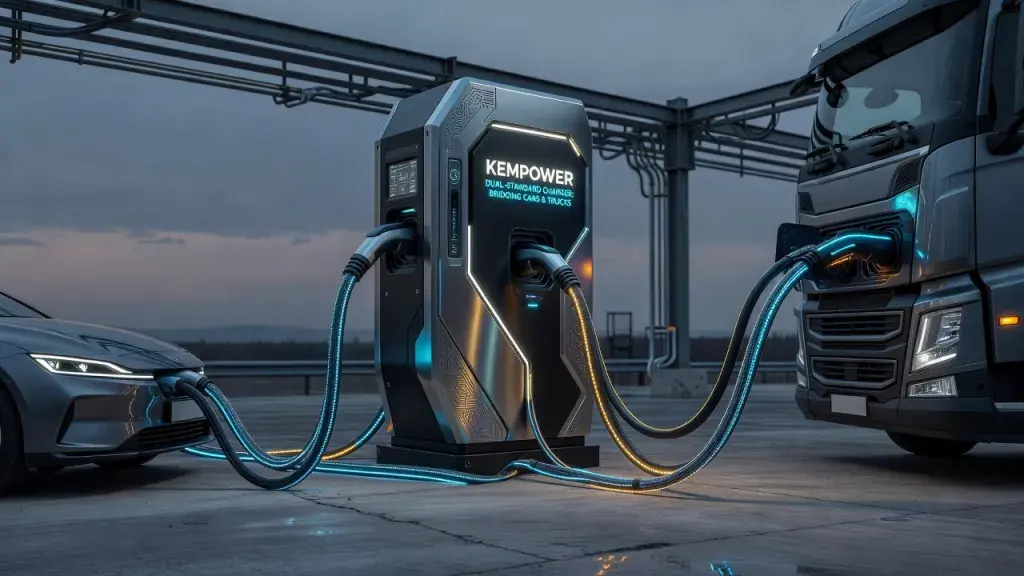
Kempower Debuts Dual-Standard Charger Bridging Cars and Trucks
Authored by dongtam.info, 20-09-2026
Kempower has introduced a charging dispenser designed to serve both passenger electric vehicles and heavy-duty electric trucks from the same unit, a move that addresses one of the more awkward problems in the buildout of charging infrastructure: the industry is running two incompatible standards at once. The new Mega Satellite Flex delivers up to 560 kW through the established Combined Charging System (CCS) and up to 1.2 MW through the emerging Megawatt Charging System (MCS), making it Kempower's first product capable of switching between the two.
The timing reflects where the market actually stands. CCS remains the dominant standard for cars and light-duty vehicles across North America and Europe, while MCS is only beginning to appear at freight corridors and depots built for electric trucks that need far more power to make sense economically. Operators planning new sites have had to choose, or build twice. Just as drivers researching a reliable vpn weigh trade-offs between speed, coverage, and cost, fleet operators and charging-site developers are weighing similar trade-offs between standards, hardware costs, and long-term flexibility as they commit capital to infrastructure that needs to last well over a decade. reliable vpn
Kempower's pitch is that a single dispenser supporting both protocols removes the need for a second buildout later. A site owner can install one unit, serve passenger cars today, and accommodate trucks as MCS-equipped fleets arrive, without ripping out equipment or adding a parallel system.
Why Megawatt Charging Exists at All
Heavy-duty trucks carry battery packs far larger than those in passenger cars, and they operate on tight schedules where extended downtime translates directly into lost freight capacity. CCS, even at its highest power levels, cannot deliver the amount of energy a truck needs within a reasonable stop. MCS was developed specifically to close that gap, pushing current up to 1,500 amps in Kempower's implementation, compared with 700 amps on the CCS side of the same unit. The cabling reflects that difference too: a 5-meter CCS cable versus a shorter, thicker 2.7-meter MCS cable built to handle the additional load safely.
Utilization as the Real Selling Point
The more consequential argument here is economic rather than technical. Charging hardware is expensive, and idle equipment is the enemy of return on investment. By letting one dispenser serve two vehicle categories, and by supporting 800-volt EV architectures that are becoming more common in newer passenger models, Kempower is betting that operators will get higher utilization from day one rather than waiting years for truck traffic to justify a dedicated MCS installation. The unit's compatibility with Kempower's existing distributed charging architecture also means operators already using that system can add the Flex without redesigning their sites.
What Comes Next
Kempower unveiled the Mega Satellite Flex at its Unplug & Recharge event held alongside ACT Expo, where the product remains on display this week. Wider commercial availability is set for North America and Europe in July 2026, giving fleet operators and site developers roughly a year to factor the dual-standard option into infrastructure plans still being drawn up.